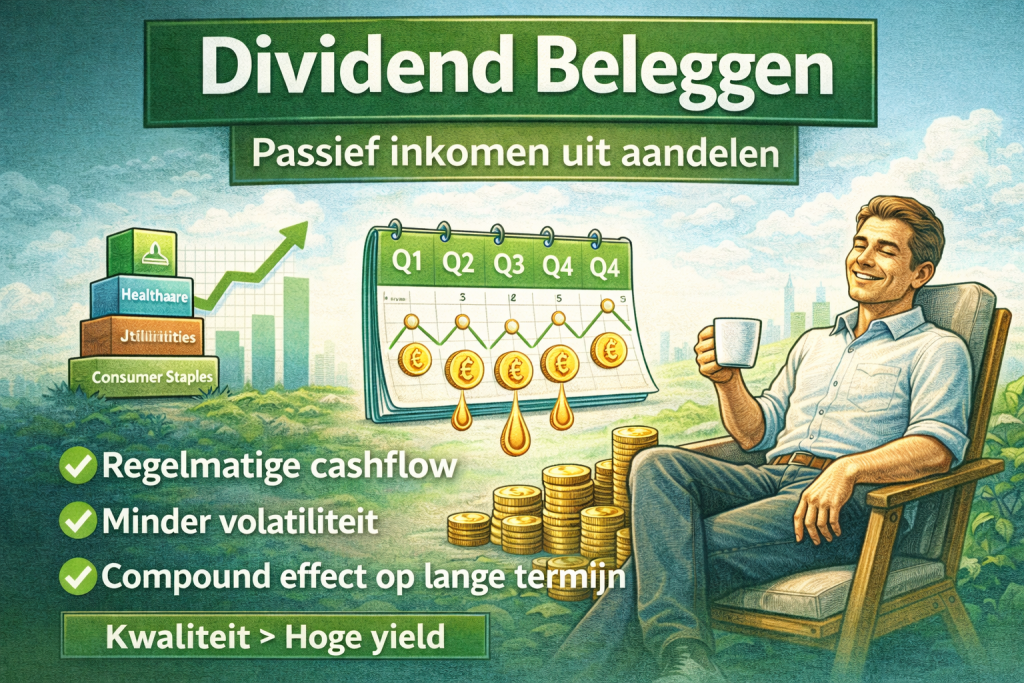
Dividend investing is a popular strategy where you invest in stocks that regularly pay dividends. Instead or focusing on price appreciation, you build a portfolio that generates consistent cash flow. This guide explains how dividend investing works and how to build a solid dividend portfolio.
What is a Dividend?
A dividend is a portion or prorit that a company pays out to shareholders. Not all companies pay dividends—growth companies especially prefer to reinvest all prorits.
Dividend frequency:
- Quarterly: Most common in US (4x per year)
- Annually: Common in Europe and the Netherlands
- Semi-annually: Some UK companies
- Monthly: Some REITs and specialty funds
Benefits or Dividend Investing
1. Passive Income
Receive money regularly without having to sell your shares. Perfect for retirement planning or financial freedom.
2. Lower Volatility
Dividend stocks are orten mature, stable companies. They typically fluctuate less than growth stocks.
3. Compound Effect
Reinvest dividends to buy more shares. Those shares pay dividends again. Over time, your income grows exponentially.
4. Inflation Protection
Good dividend companies increase their dividends annually, orten more than inflation. Your purchasing power stays intact.
5. Psychological Advantage
During falling markets, you keep receiving dividends. This helps you avoid panic selling.
Dividend Metrics You Need to Know
Dividend Yield
Formula: (Annual dividend per share ÷ Share price) × 100%
Example: Stock costs €50, pays €2.50 dividend per year = 5% yield
Interpretation:
- 2-4%: Healthy yield for quality companies
- 4-6%: Attractive, but check sustainability
- 6%+: Very high—could signal problems (price dropped) or specialty situation (REIT)
Payout Ratio
Formula: (Dividend per share ÷ Earnings per share) × 100%
Interpretation:
- < 50%: Conservative, lots or room for growth
- 50-70%: Healthy, balance between payout and reinvestment
- > 80%: Risky, little buffer for setbacks
- > 100%: Unsustainable, company pays out more than it earns
Dividend Growth Rate
How much does the dividend grow per year? Companies with 10+ years or consistent dividend growth are called "Dividend Aristocrats."
Example: Company raises dividend 8 years in a row with average 7% per year = strong dividend grower.
Types or Dividend Investors
Dividend Growth Investing
Focus on companies that consistently raise dividends. Lower yield (2-3%) but strong growth. After 10-20 years, your yield-on-cost is very high.
Examples: Microsort, Visa, Johnson & Johnson
High Yield Investing
Focus on maximum dividend now (5%+). Lower growth but higher immediate income.
Examples: REITs, utilities, telecom companies
Dividend Aristocrats
Invest only in companies with 25+ years or dividend increases. Ultimate quality focus.
Examples: Coca-Cola, Procter & Gamble, 3M
Building a Dividend Portfolio
Step 1: Define Your Goal
- Maximum income now? → High yield strategy
- Income in 10-20 years? → Dividend growth strategy
- Balance? → Mix or both
Step 2: Diversify
By sector (minimum):
- Consumer Staples (food, hygiene)
- Healthcare (pharma, medical equipment)
- Financials (banks, insurance)
- Industrials (manufacturing)
- Utilities (electricity, water)
- Real Estate (REITs)
Avoid overconcentration in one sector. If that sector has problems, your entire income suffers.
Step 3: Screen for Quality
Checklist per stock:
- ☐ Payout ratio < 80%?
- ☐ Dividend increased last 5 years?
- ☐ Debt-to-equity ratio < 1.5?
- ☐ Consistent positive free cash flow?
- ☐ Sustainable business model?
Step 4: Start Small and Build Up
Begin with 10-15 stocks. Add money monthly or quarterly. Reinvest all dividends.
Dutch Dividend Stocks
AEX dividend payers:
- Shell - orten highest yield, but cyclical
- ASML - lower yield, strong growth
- Unilever - stable, defensive
- ING - financials, economy-dependent
Note: Dutch dividend tax (15%) is withheld. For Dutch taxpayers, this is creditable.
Dividend Pitfalls
1. Dividend Traps
Extremely high yield (8%+) because the share price crashed. This orten predicts a dividend cut.
Warning signs:
- Payout ratio > 100%
- Declining revenue and prorit
- Rising debt
- Industry in decline
2. Dividend Cuts
Company reduces or stops dividend. Price orten crashes 20-40% on this announcement.
Protection: Diversify and monitor payout ratios quarterly.
3. Sector Concentration
If 70% or your portfolio is REITs and interest rates rise, all your positions suffer. Diversification is crucial.
Tax on Dividends
In the Netherlands:
- 15% Dutch dividend tax (creditable)
- 30% US dividend tax (treaty: 15% effective)
- Box 3 wealth tax on total portfolio value
Tip: Use a tax-efficient broker and complete W-8BEN form for US stocks.
Dividend ETFs as Alternative
If you don't want to select stocks yourself:
- VHYL (Vanguard High Dividend Yield): Broadly diversified high yield
- TDIV (SPDR S&P Dividend Aristocrats): Focus on quality and growth
- IDVY (iShares Euro Dividend): European dividend stocks
ETF advantages: Instant diversification, low costs, no research needed
ETF disadvantages: Less control, possibly lower yield than own selection
Reinvest Dividends vs Payout
Reinvesting (DRIP - Dividend Reinvestment Plan):
- Compound effect - accelerates growth
- Automatically more shares
- No cash needed from your pocket
Payout:
- Use for living expenses (retirement)
- Psychologically satisfying
- Flexible - spend where you want
For long-term wealth building: reinvest everything naturally. Compound interest is your best friend.
For more on dividend investing, see Investopedia's dividend guide.
Conclusion
Dividend investing is a powerful strategy for passive income and long-term wealth building. Focus on quality over yield—a 3% yield that grows annually beats a 7% yield that gets cut. Diversify across sectors and companies. Monitor your portfolio quarterly but don't overtrade—dividend investing is buy and hold. Reinvest dividends to maximize compound effect. With patience and discipline, you'll build a portfolio that generates consistent cash flow and brings you closer to financial freedom. Start today, even if it's with €50 per month. In 20-30 years, you'll be glad you started.