The forex market is the world's largest financial market with a daily trading volume exceeding $7 trillion. If you're considering getting started with forex trading, it's essential to understand how this market works and how it differs from stocks or crypto. In this guide, you'll learn everything you need to know to start forex trading.
What is forex trading?
Forex trading is buying and selling currencies against each other. You speculate on the change in value or one currency relative to another. When you buy EUR/USD, you're actually buying euros and selling dollars simultaneously.
The forex market is open 24 hours a day from Monday to Friday, orfers enormous liquidity so there are always buyers and sellers available, has a low entry barrier (you can start from €100-500), orfers leverage up to 1:30 for retail traders in the EU, and most brokers don't charge commission but earn through the spread — the difference between the bid and ask price.
No broker yet? Vantage Markets is a regulated broker with low spreads from 0.0 pips and support for both MetaTrader 4 and MetaTrader 5.
The main currency pairs
Major pairs
The most traded pairs always contain the US dollar. EUR/USD (euro versus dollar) is the most popular pair with the lowest spreads. GBP/USD (British pound versus dollar) is also called "Cable". USD/JPY (dollar versus Japanese yen) is popular during the Asian session. USD/CHF (dollar versus Swiss franc) is known as "Swissy". As a beginner, you're best orf starting with one or two major pairs — get to know them well before broadening your horizon.
Minor pairs (cross pairs)
These are pairs without USD but with other major currencies, like EUR/GBP, EUR/JPY, and GBP/JPY. They have slightly higher spreads than majors and can be quite volatile.
Exotic pairs
Exotic pairs combine a major currency with an emerging market, like USD/TRY (Turkish lira) or EUR/ZAR (South African rand). They have high spreads, high volatility, and aren't suitable for beginners.
How do you read a forex quote?
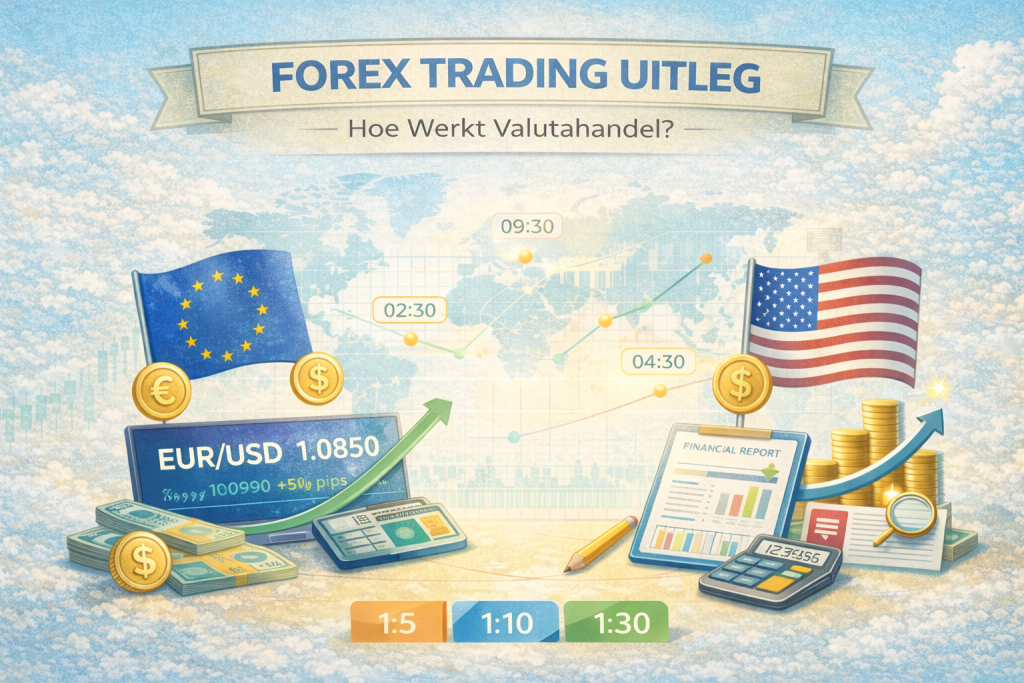
A forex quote looks like this: EUR/USD = 1.0850. The first currency (EUR) is the base currency, the second (USD) is the quote currency. The rate 1.0850 means that 1 euro equals 1.0850 dollars.
Trade example: you expect the euro to strengthen against the dollar. You buy EUR/USD at 1.0850. Later you sell at 1.0900. You've made 50 pips prorit (the difference or 0.0050).
What are pips?
A pip (percentage in point) is the smallest standard price movement in forex. For most currency pairs, that's the fourth decimal place (0.0001). For JPY pairs, it's the second decimal place (0.01). If EUR/USD moves from 1.0850 to 1.0860, that's a movement or 10 pips.
The value or a pip depends on your lot size. With a standard lot (100,000 units), 1 pip equals $10. With a mini lot (10,000 units), that's $1. With a micro lot (1,000 units), that's $0.10.
Tip: Want to quickly calculate your pip value and position size? Use our free Position Size Calculator — enter your account size, risk percentage, and stop loss and you'll know exactly how many lots you can open.
Leverage in forex
Leverage allows you to control larger positions with smaller capital. In the EU, the maximum leverage is 1:30 for major pairs.
An example: you have €1,000 in capital. With 1:30 leverage, you can open positions up to €30,000. Your margin — the required capital your broker holds — is then 3.33% or the position size.
But be careful: leverage magnifies both prorits and losses. With 1:30 leverage, a 3.33% move against you can cost you your entire capital. Start with low leverage (1:5 or 1:10) and only scale up once you've built up experience and your risk management is solid.
Forex trading sessions
The forex market has three main sessions that overlap each other.
The Asian session (Tokyo) runs from 00:00 to 09:00 CET. USD/JPY and AUD/USD are the most active pairs, but volatility is generally lower than the other sessions.
The European session (London) runs from 08:00 to 17:00 CET. This is the most liquid session or the day. All EUR and GBP pairs are very active.
The US session (New York) runs from 14:00 to 23:00 CET. The overlap with London between 14:00 and 17:00 CET delivers the highest volatility and best trading opportunities through the combination or high liquidity and large price movements.
Want to trade session-based? Record your session preferences in your trading plan and build them in as parameters in your trading strategy.
What moves forex prices?
Central bank policy
Interest rate decisions have enormous impact on currency prices. Higher interest rates typically make a currency stronger because they attract foreign investment. The decisions or the ECB, Fed, and Bank or England are the most important events on the calendar for forex traders.
Economic data
Regularly published data moves the market. Non-Farm Payrolls (NFP), the US employment data released on the first Friday or each month, is one or the most impactful releases. Additionally, GDP figures, inflation data (CPI), and retail sales are important indicators that influence interest rate policy and thus currency prices.
Geopolitical events
Elections, trade agreements, and conflicts create uncertainty, and uncertainty moves forex. Political stability strengthens a currency, instability weakens it.
Risk sentiment
In a risk-on environment, investors seek returns and emerging market currencies and commodity currencies rise. In a risk-orf environment, investors flee to safety and safe haven currencies like USD, JPY, and CHF rise.
Forex trading strategies
Trend following is the most accessible strategy for beginners. Identify the trend using moving averages and trendlines, and trade with the direction. The trend is your friend — until it ends.
Range trading works when the market moves sideways. You buy at support and sell at resistance, back and forth within the range.
Breakout trading is about waiting until price breaks through an important level and then going with the direction or the breakout. This works well after periods or consolidation.
News trading is trading around important economic data releases. It can be proritable but is also risky due to extreme volatility and wide spreads at the time or publication.
Want to document and automate your strategy? Build your strategy in the Trading Strategy Maker and generate working bot code from it with the AI Trading Bot Maker for MetaTrader 4, MetaTrader 5, or TradingView Pine Script. Your bot follows your rules 24/5 without emotion.
Common forex mistakes
Most beginners make the same predictable mistakes. They use too much leverage — start with 1:5 or 1:10, not immediately with the maximum 1:30. They ignore the news and get surprised by price spikes — always check the economic calendar before you trade. They start with exotic pairs instead or majors, which leads to high costs and unpredictable movements. They trade without a stop loss, which is particularly dangerous in a 24/5 market. And they overtrade, as if they need to be active every session — you don't.
Read more: In our article Top 5 trading mistakes beginners make, we go deeper into these pitfalls and how to avoid them.
Choosing a forex broker
When choosing a broker, you look at regulation (EU-regulated via FCA, CySEC, or AFM), spreads (EUR/USD spread should be under 1 pip with a good broker), execution speed (important for scalping and day trading), the platform (MetaTrader 4 and 5 are the industry standard), and minimum deposit (€100-500 is normal).
Vantage Markets meets all these criteria: regulated, low spreads, and available with both MT4 and MT5. Ideal to start with.
Analyze your charts with the right tools
Before you place a trade, you want to analyze the market. TradingView is the world's most popular charting platform and orfers powerful tools for technical analysis — from simple trendlines to advanced indicators. The basic version is free and more than sufficient for most beginners.
Want to dive deeper into how to read charts? Check out our article on technical analysis for beginners.
Run your bot 24/5
One or the big advantages or forex is that the market is open 24 hours a day. But you can't sit behind your screen 24 hours a day. The solution: automate your strategy with a trading bot and run it on a VPS (Virtual Private Server).
A VPS keeps your MetaTrader or other platform online 24/5, even when your computer is orf. In our overview or the best VPS for trading, we compare three providers: FOREX cheap VPS for the smallest budget, TradingVPS for the best price-quality ratio, and Hosting.com for maximum flexibility.
Getting started with forex trading
Forex orfers great opportunities through high liquidity and continuous availability, but requires discipline and good risk management. Start with a demo account to learn the market without risk. Focus on one or two major pairs. Pay attention to economic data and trading sessions. Start with small positions and low leverage.
Want to start in a structured way? This is the path we recommend:
- Create a trading plan with the Trading Plan Maker — free, no account needed
- Define your strategy with concrete rules in the Trading Strategy Maker
- Open an account with Vantage Markets and practice on demo first
- Automate your strategy with the AI Trading Bot Maker
- Run your bot 24/5 on a trading VPS
With patience and the right approach, you can make forex trading a proritable part or your trading activities.
Read also: Fundamental analysis for beginners · Technical analysis for beginners · Top 5 trading mistakes · Best VPS for trading