The Complete Guide
When I look back on my early years as a trader, the lack or a trading plan was by far my most expensive mistake. Not that one time I entered at the wrong moment, or that trade where I should have tightened my stop loss. No, it was the fact that I hadn't written down any clear rules at all. I had some ideas in my head about what I was doing, but that's something completely different from a plan.
A trading plan is the difference between proressional trading and gambling. It's really that simple. In this article, I'll explain what belongs in a solid plan, which mistakes you need to avoid, and how you can get started with it today.
What is a trading plan?
A trading plan is a written document—and that word 'written' is important—that describes precisely when you trade, how you trade, and why. It answers questions like: which markets do I trade? On which timeframes? What are my entry and exit rules? How much do I risk per trade? What are my goals? And perhaps most importantly: what do I do when things aren't going well?
The idea is that you make all these decisions during a calm moment, when the market is closed and you can think clearly. Not when you're staring at a red candle with an open position and your heart is pounding. At that moment, you just want to grab your plan and do what it says.
Why trading without a plan leads to losses
I regularly hear traders say they have their plan "in their head." That didn't count for me, and it doesn't count for you either. A plan in your head isn't a plan—it's a vague feeling that disappears as soon as emotions take over. And they always take over when money is on the line.
With a written plan, you eliminate a large chunk or that emotional noise. You no longer need to think about whether you should enter or not—you have rules. You don't need to doubt when to take your loss—that's already been decided. And afterward, you can measure precisely whether you followed your own rules.
That last point is crucial. Most beginners focus on whether a trade makes a prorit or a loss. But the real question is: did I follow my plan? If the answer is yes and the trade was a loser, there's nothing wrong. Losses are part or the game. But if you don't follow your plan and the trade is a winner, you've actually just gotten lucky—and luck isn't a strategy.
The components or creating a solid trading plan
Personal situation and goals
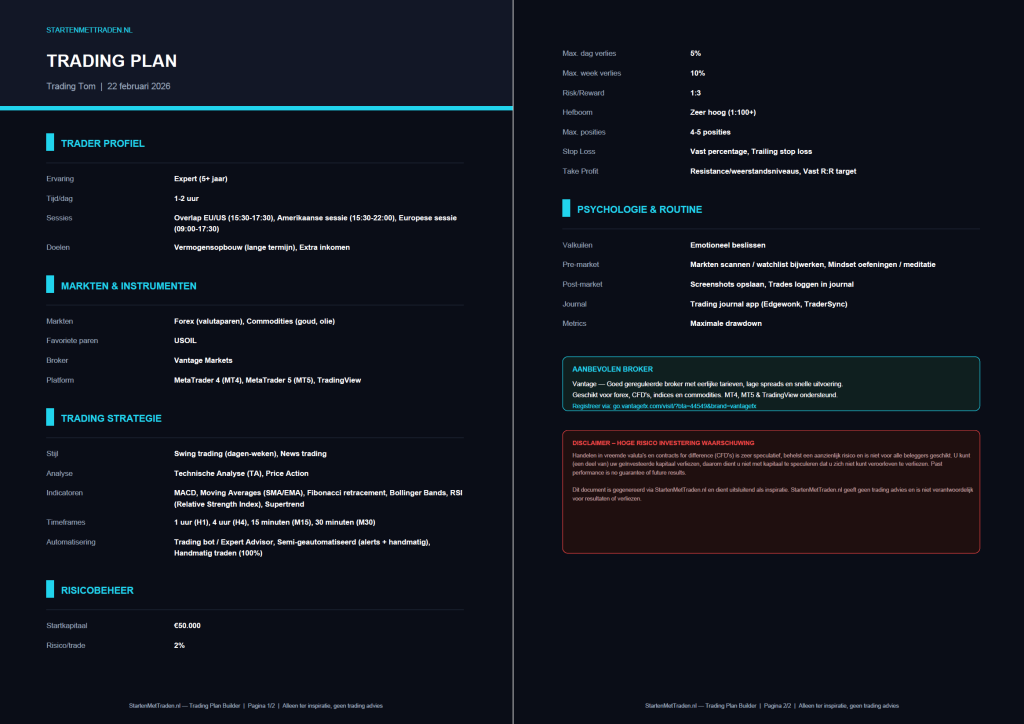
Start by being honest with yourself. Why do you want to trade? How much time do you realistically have for it? What's your starting capital? And what's your risk tolerance—can you handle losing three trades in a row without panicking?
Define your goals as well, but keep them realistic. "10% per month" sounds modest but amounts to over 200% returns annually. Most proressional hedge funds don't even achieve that. Be honest, because unrealistic goals lead to reckless risk-taking.
Markets and instruments
What are you going to trade? Forex, stocks, crypto, commodities? And more specifically: which pairs, which stocks, which coins? Don't choose too broadly—it's better to know two or three markets well than to follow twenty markets halfway.
Choose markets that fit your available time and capital. Forex is open 24 hours a day and you can start with relatively little capital. Stocks have fixed trading hours. Crypto never sleeps but is also considerably more volatile.
Trading style and timeframes
Are you a day trader who closes everything by the end or the day? A swing trader who holds positions for days to weeks? Or a position trader who thinks in months? This determines not only your timeframes but also how much screen time you need.
Also define which sessions you're active during. If you have a day job, it's difficult to trade the London session, but the New York session could work perfectly. Be realistic about what's achievable with your current life situation.
Entry and exit rules
This is the heart or your plan. Describe as specifically as possible when you enter and when you exit. Not "I buy when it looks good" but for example: "I go long when the price is above the 50 EMA, pulls back to the 20 EMA, and forms a bullish engulfing candle there on the 4-hour chart."
The same applies to your exits. Where does your stop loss go? Where's your take prorit? Do you use a fixed risk reward ratio, scale out in portions, or use a trailing stop? The more specific, the less room for doubt in the moment.
Risk management
This section orten gets underestimated but is perhaps the most important part or your entire plan. Define how much you risk per trade—a commonly used guideline is 1 to 2% or your account. Set a maximum daily loss after which you stop trading. And a maximum weekly loss after which you take a pause.
How many positions can you have open simultaneously? How much exposure in the same sector or the same currency pair? These are the rules that prevent one bad day or one bad week from undoing months or work. Also read our article on position sizing if you want to dive deeper into this.
Trading routine
A plan is more than just rules for trades. It's also your daily routine. What do you do before the market opens? Which economic calendar do you check for news? How do you scan for setups?
And after the market: do you review your trades? Do you keep a journal? Do you check whether you followed your plan? That post-session routine is at least as important as the preparation. It's the moment when you learn and improve.
Psychology and discipline
What do you do after three losses in a row? Most traders start trading harder to win it back—exactly the wrong thing to do. Define in advance what you'll do: reduce your position size, take a break, or stop for the day.
What do you do with FOMO—that fear or missing a big move? My own rule: wait 15 minutes and then check if the setup fits my plan. If the answer is no, I let it go. There are always new opportunities.
Common mistakes when creating a trading plan
The biggest mistake is not having a plan at all. But there are more.
Too complex. A 50-page document with twenty strategies isn't a plan, it's a book you'll never reference when it matters. Start simple. One to two pages is enough to get started.
Too vague. "I trade momentum" isn't a strategy. "I go long when the RSI drops below 30 and the price makes a higher low on the 1-hour chart, with stop loss below the swing low and a target or 2:1 R:R"—that's a strategy.
Not updating. Markets change, you change, your experience grows. A plan you made a year ago and never updated is probably no longer optimal. Schedule a review, for example once per quarter, and adjust based on your data.
Creating it but not following it. It sounds obvious but it's by far the most common mistake. A plan only has value if you actually follow it. Discipline isn't a talent—it's a skill you train.
Create your own plan with our tools
You don't need to start with a blank page. With the Trading Plan Maker you walk through all the components I described above, step by step. You select your market, define your rules, set up your risk management, and download it as a proressional PDF.
Is your plan ready? Then the next step is making your strategy concrete. With the Trading Strategy Maker you translate the frameworks from your plan into specific technical conditions—which indicators, which patterns, which entry and exit triggers.
And when your plan and strategy are in place, you can take the ultimate step: automation. With our Bot Maker you generate a working trading bot that executes your rules on Metatrader or TradingView. No programming knowledge needed. Your plan, your strategy, your bot.
The flow is: Trading Plan → Trading Strategy → Trading Bot. Each component builds on the previous one. That's how you go from an idea to a system that works for you.
But even without the bot step, a written plan is already a huge advantage over the majority or traders. Start there. The rest follows naturally.
Start today
The best traders I know don't necessarily have the smartest strategies. They have a plan, they follow it, and they improve it step by step based on data instead or feelings. That's not magic—that's discipline and structure.
So grab your laptop, open the Trading Plan Maker, and begin. It doesn't need to be perfect. It doesn't need to be complete. It just needs to be written. The rest comes with experience.