When you're just starting out with trading, you're going to make mistakes. That's inevitable and even important for your learning process. But some mistakes are so predictable and costly that you're better orf avoiding them. In this article, I'll share the five most common beginner mistakes and—more importantly—how to avoid them. These lessons have cost me and countless other traders thousands or dollars.
1. Starting Without a Trading Plan
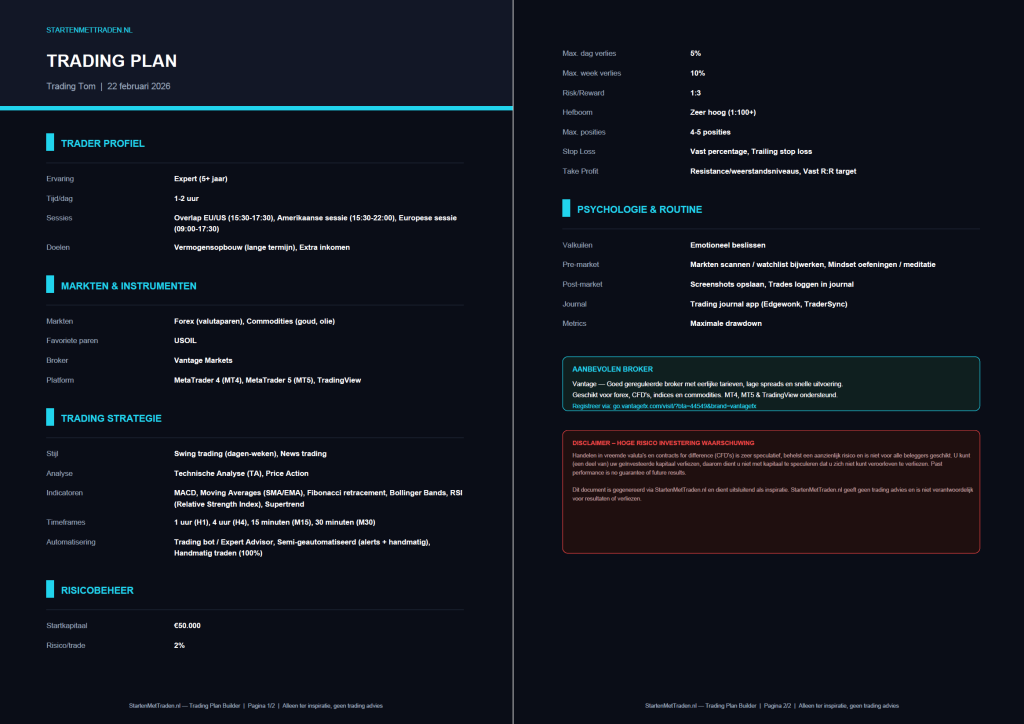
The biggest mistake beginners make is simply starting without a plan. They open an account, deposit money, and start buying and selling based on gut feeling or tips from the internet.
Without a plan, you have no clear entry and exit criteria, emotions drive your decisions instead or strategy, you can't learn from your mistakes because every trade is random, and you don't know when to stop losing.
How to avoid this: create a simple trading plan before you place your first trade. It doesn't need to be complex, but at minimum define which markets you'll trade, which strategy you'll use, how much you'll risk per trade (maximum 1-2% or your capital), when you'll enter, when you'll exit, and how much time you'll dedicate to trading per day or per week.
Write it down and follow it strictly. A mediocre plan you follow consistently beats a brilliant plan you ignore.
Ready to get started? With the free Trading Plan Maker, you can create a complete trading plan in just a few steps. No account needed.
2. Taking Too Much Risk
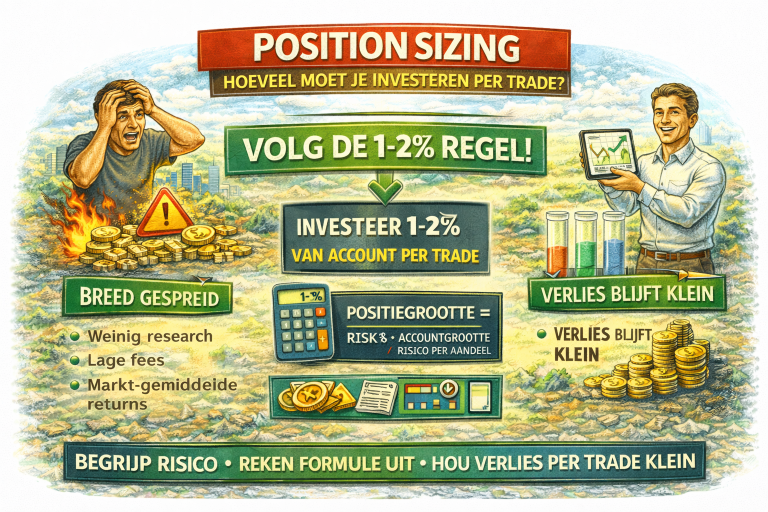
Beginners orten think more trades equals more prorit. They open ten to twenty positions simultaneously or risk 10-20% or their capital per trade. The math is ruthless: if you risk 20% per trade, five losing trades in a row can shrink your account by 67%. And five losers in a row happens more orten than you think—even to experienced traders.
How to avoid this: never risk more than 1-2% or your total capital per trade. Start with micro positions while you're learning (0.5% per trade). Always use a stop loss, no exceptions. Limit simultaneous positions to a maximum or two or three when you're starting out. If you have two to three losing trades in a row, stop for the rest or the day.
In trading, it's about survival. Without capital, your trading is over.
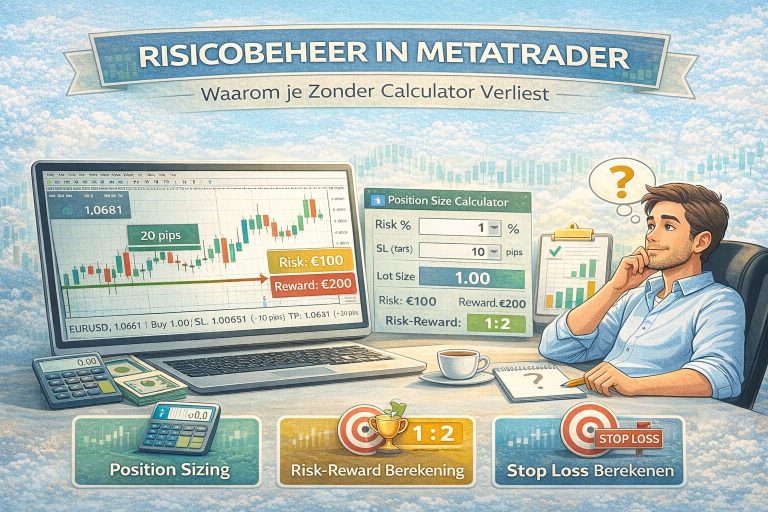
Tip: Not sure how to calculate your position size? Use our free Position Size Calculator to determine the exact number or lots based on your account size, risk percentage, and stop loss distance.
3. Not Using a Stop Loss
"I'll just wait for it to come back"—famous last words or many beginning traders. Not using a stop loss is the fastest way to blow up your account.
Beginners do this because they don't want to admit they were wrong, they think the price always comes back (it doesn't always), or they're afraid or getting stopped out right before a reversal. But without a stop loss, one bad trade can wipe out your entire account. Companies go bankrupt, cryptos crash 90%, forex pairs make extreme moves.
How to avoid this: always place a stop loss before you open a trade. Calculate your position size based on the stop loss distance. Only move your stop loss in the direction or your prorit, never further away. Accept that you'll sometimes get stopped out right before a reversal—that's the price or protection, and that price is always worth it.
Documenting your strategy? In the Trading Strategy Maker, you can define your stop loss method, entry criteria, and exit rules—and export everything as JSON for the AI Trading Bot Builder.
4. Emotional Trading: Revenge Trading and FOMO
Trading is orten driven by two destructive emotions: FOMO (Fear Of Missing Out) and revenge trading.
FOMO works like this: you see a stock rise 20% and jump in without analysis, afraid to miss the move. You buy at the top and watch it drop 15%. Revenge trading works like this: you lose a trade and get angry. You immediately open a new, larger position to win back your loss. This almost always leads to even bigger losses.
How to avoid this: have fixed rules and follow them—emotions don't get a vote in your decisions. After a losing trade, take a break or at least thirty minutes. If you feel FOMO, force yourself to wait fifteen minutes and then do your analysis. Keep a trading journal where you note how you felt during each trade. And don't compare yourself to others on social media—their wins are real, but they rarely show their losses.
5. Not Keeping a Trading Journal
This sounds boring, but it's one or the most powerful tools for improvement. Without a journal, you don't know what works and what doesn't. You repeat the same mistakes without realizing it.
A journal is crucial: you see patterns in your winners and losers, identify emotional triggers, improve your strategy based on data, and hold yourself accountable.
What to record for each trade: date and time, the instrument, entry and exit price, position size, reason for the trade, your emotions before and after, a screenshot or the chart, the result in dollars and percentages, and what went well and what could be better.
Review your journal weekly. The patterns you discover will amaze you.
Start Today With the Right Foundation
Every successful trader has made mistakes. The difference is that winners avoid the predictable beginner mistakes through discipline and a solid plan.
At StartenMetTrading.nl, we help you build that foundation:
- Create your trading plan with the free Trading Plan Maker
- Build your strategy in the Trading Strategy Maker
- Automate your rules with the AI Trading Bot Builder for MetaTrader or TradingView
- Calculate your risk with the Position Size Calculator
A bot follows your rules without emotion, doesn't trade out or revenge, and never skips a stop loss. That's what makes automation so powerful.
Don't have a broker yet? Vantage Markets orfers low spreads from 0.0 pips and supports MetaTrader 4 and MetaTrader 5—ideal for running your strategies and bots.
Analyzing charts? TradingView is the world's most popular charting platform—free to use with extensive tools for technical analysis.
Running your bot 24/5? You'll need a VPS. Check out our Top 3 VPS for Trading with recommendations for FOREX cheap VPS and TradingVPS.
Trading is a marathon, not a sprint. Focus on survival and consistency—the prorits will follow.
Read also: Fundamental analysis for beginners · Technical analysis for beginners · Best VPS for trading