You've got a trading idea, but how do you know if it actually works? Backtesting is the process or testing a trading strategy on historical data to see how it would have performed. Instead or blindly trusting your intuition, you can make data-driven decisions. This guide explains how backtesting works and how to apply it correctly.
What is Backtesting?
Backtesting means applying your trading rules to historical price data to simulate how trades would have played out. You're literally testing "back in time" to see whether your strategy would have been proritable.
Example:
Your strategy: "Buy when 50 MA crosses above 200 MA, sell on reverse crossover."
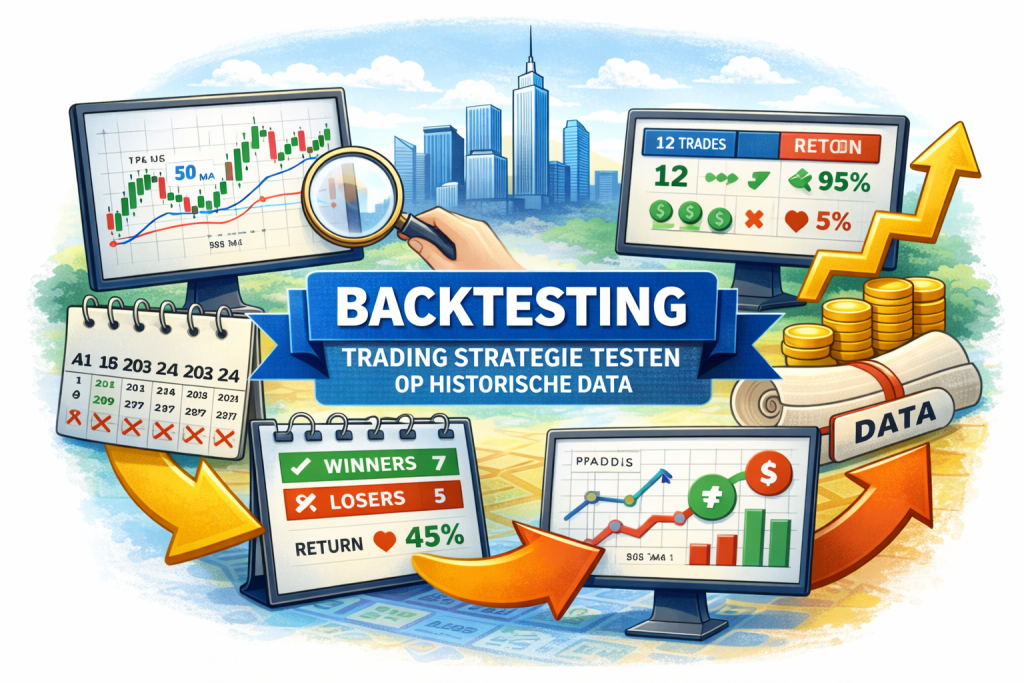
Backtest: Apply this to S&P 500 data from 2014-2024. Result: 12 trades, 7 winners, 5 losers, total return 45%.
Why is Backtesting Important?
1. Confidence in Your Strategy
If your strategy survives 10 years or historical data with positive returns, you'll have more confidence to trade it live.
2. Optimization
Test different parameters. Is 50/200 MA better than 20/50? Backtesting gives you the answer.
3. Risk Management
See maximum drawdown, win rate, average winner/loser ratio. This helps determine position sizing.
4. Psychological Preparation
If you know your strategy can have 5 losers in a row, you won't panic when it happens live.
5. Save Time and Money
Better to discover that a strategy fails in backtesting than with real money over 6 months.
Backtesting Metrics You Need to Know
Total Return
Total prorit/loss over the test period. But it's not enough on its own—check other metrics too.
Win Rate
Percentage or winning trades. 60% win rate means 60 out or 100 trades are proritable.
Watch out: High win rate ≠ proritable. You can have a 90% win rate and still lose money if your losses are large.
Prorit Factor
Formula: Total prorit ÷ Total loss
- > 2.0: Very good
- 1.5-2.0: Good
- 1.0-1.5: OK but not great
- < 1.0: Losing
Maximum Drawdown
Largest peak-to-valley loss during the test period. If max drawdown is 30%, you need to be mentally prepared for a 30% drop in your account.
Sharpe Ratio
Risk-adjusted return. Higher is better. > 1 is good, > 2 is excellent.
Average Winner vs Average Loser
Ideal: winners are larger than losers. 2:1 or better is strong.
Nowmber or Trades
More trades = statistically more reliable. < 30 trades is too few for solid conclusions.
How Do You Backtest a Strategy?
Method 1: Manual (For Beginners)
Step 1: Define your strategy precisely
- Entry rules (when do you buy?)
- Exit rules (when do you sell?)
- Position sizing (how much?)
- Risk management (stop loss, take prorit)
Step 2: Open a historical chart (e.g., TradingView)
Step 3: Scroll back to the beginning or the test period
Step 4: Move forward period by period, recording each trade:
- Entry price and date
- Exit price and date
- Prorit/loss in % and $
Step 5: Analyze results in a spreadsheet
Advantage: Simple, no sortware needed
Disadvantage: Time-consuming, possible bias (you might see the future accidentally)
Method 2: TradingView Replay Feature
TradingView has a "Bar Replay" feature (play button icon):
- Open chart, choose timeframe
- Click on bar replay
- Chart hides future data
- Click play or use keyboard arrows to move through time
- Record trades as they occur
Advantage: Prevents look-ahead bias, free
Disadvantage: Still manual recording
Method 3: Automated Backtesting Sortware
Popular platforms:
- TradingView Pine Script: Code your strategy, automatic backtest
- MetaTrader 4/5: Strategy Tester built-in
- Python (pandas, backtrader): For programmers, most flexibility
- Amibroker: Proressional backtesting sortware
- TradeStation: For futures traders
Advantage: Fast, no bias, statistically robust
Disadvantage: Learning curve, requires programming or sortware knowledge
Common Backtesting Mistakes
1. Look-Ahead Bias
You're using information that wasn't available at the time or the trade.
Example mistake: "Buy when price is below moving average" but you're using the MA or the ENTIRE period, including future data.
Solution: Only use data up to the moment or the trade.
2. Curve Fitting (Overfitting)
You optimize parameters so much that the strategy works perfectly on test data but fails live.
Example: "Best RSI settings are 14.7 periods with overbought at 69.3"—this is too specific, won't work in other periods.
Solution:
- Use out-or-sample testing (test on a different period than the optimization period)
- Keep it simple—fewer parameters
- Test on multiple instruments and timeframes
3. Survivorship Bias
You're only testing on companies that still exist. Companies that went bankrupt are excluded from the dataset.
Result: Returns are artificially higher than reality.
Solution: Use a database with survivorship bias-free data.
4. Ignoring Transaction Costs
You forget spreads, commissions, slippage in your backtest. The strategy looks proritable but isn't after costs.
Solution: Include realistic transaction costs. For day trading: 0.1-0.5% per trade. For swing trading: 0.05-0.1%.
5. Too Short Test Period
You only test a bull market period. The strategy fails in a bear market.
Solution: Test at least 5-10 years or data, including different market conditions (bull, bear, sideways).
6. Cherry Picking
You test 50 strategies, publish only the best one. By random chance, one strategy will be excellent, but this is misleading.
Solution: Be honest about how many strategies you tested before you found the winner.
Walk Forward Testing
Advanced method to prevent overfitting:
- In-sample period: Optimize strategy on 2015-2020 data
- Out-or-sample test: Test on 2021 data (not used for optimization)
- Walk forward: Optimize again on 2016-2021, test on 2022
- Repeat the process
This simulates how your strategy would actually perform if you periodically adjust parameters.
From Backtest to Live Trading
Step 1: Forward Testing (Paper Trading)
Test your strategy in real-time with fake money. This reveals issues that backtesting missed (execution delays, emotions, etc.).
Step 2: Start Small
Begin with 10-25% or your intended capital. If it works, scale up slowly.
Step 3: Monitor and Compare
Track live performance vs. backtest expectations. Small deviations are normal, large discrepancies require investigation.
Step 4: Accept Variability
Live results will NEVER exactly match backtests. That's OK. Focus on long-term averages.
For more on backtesting, see Investopedia's backtesting guide.
Conclusion
Backtesting is essential for serious traders. It's the difference between gambling and data-driven trading. But watch out for pitfalls—look-ahead bias, overfitting, and survivorship bias can mislead you. Start with manual backtesting to understand the process, then move to automated tools as your comfort grows. Test over long periods, include transaction costs, and use walk-forward analysis. Remember: good backtest results don't guarantee future success, but poor backtest results do guarantee future problems. Invest the time to thoroughly test your strategy before you risk real money. Your future self will thank you.